Connect securely
Use direct or SSH routes, PostgreSQL SSL modes, client certificates, read-only sessions and explicit transactions.
LakeDB Beta 6.0
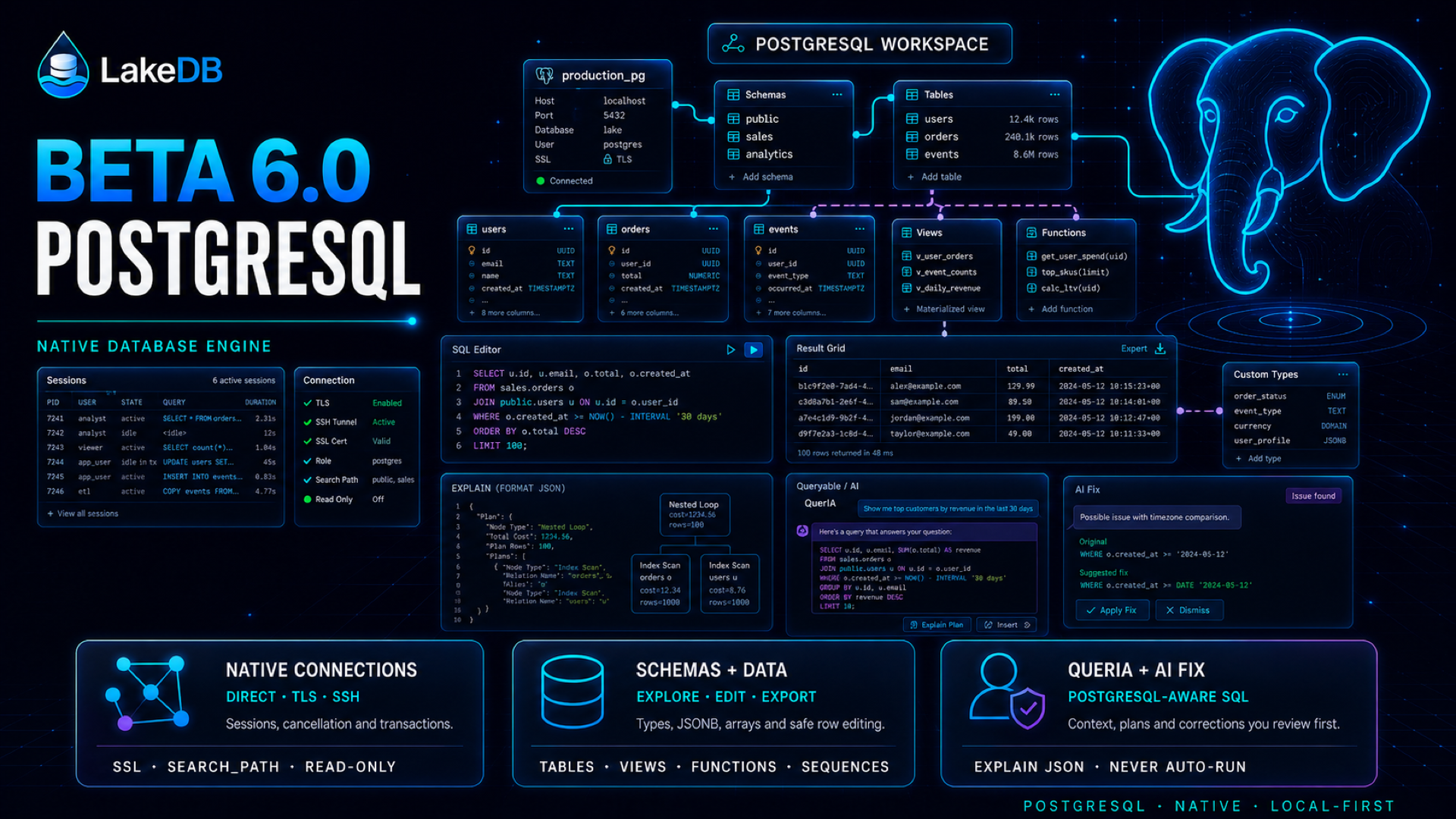
Connect, explore, edit, design, export, operate and use review-first AI through PostgreSQL-specific runtime behavior.
Windows x64 macOS Apple Silicon Linux x64
01 / Beta 6.0
LakeDB uses PostgreSQL-specific connections, catalogs, quoting, types and plans instead of translating through another engine.
Use direct or SSH routes, PostgreSQL SSL modes, client certificates, read-only sessions and explicit transactions.
Browse schemas, materialized views, overloaded functions, sequences, types, keys, indexes and constraints.
Edit with stable identities, inspect plans, design and transfer tables, or ask QuerIA and AI Fix without automatic execution.
02 / QuerIA
QuerIA is a line-based query document beside your SQL tabs. Use Normal generation for focused requests or Agentic generation when the answer may require more tables, relationships and index review.
Use Normal generation for a direct draft or Agentic generation for deeper investigation.
The agent can read relevant structures, keys and indexes across accessible databases.
SELECT plans are reviewed with EXPLAIN and their index signals are shown beside the SQL.
The complete statement stays visible. Only you can execute it through the normal connection.
02 / Real examples
Beta 4.5 combines reviewable SQL with local result filters, draggable result columns and safer everyday SQL editing.
SELECT u.id, u.email,
       COUNT(b.id) AS bet_count,
       SUM(b.stake) AS total_stake
FROM users AS u
JOIN users_bets AS b ON b.user_id = u.id
WHERE b.created_at >= CURRENT_DATE()
  AND b.created_at < CURRENT_DATE() + INTERVAL 1 DAY
GROUP BY u.id, u.email
ORDER BY total_stake DESC
LIMIT 10;INSERT INTO users (email)
VALUES ('ada@example.com');CREATE TABLE user_segments (
id BIGINT UNSIGNED NOT NULL AUTO_INCREMENT,
name VARCHAR(120) NOT NULL,
description TEXT NULL,
created_at TIMESTAMP NOT NULL DEFAULT CURRENT_TIMESTAMP,
updated_at TIMESTAMP NOT NULL DEFAULT CURRENT_TIMESTAMP
ON UPDATE CURRENT_TIMESTAMP,
PRIMARY KEY (id),
UNIQUE KEY uq_user_segments_name (name)
) ENGINE=InnoDB DEFAULT CHARSET=utf8mb4;UPDATE users
SET email = 'ada.lovelace@example.com'
WHERE id = 7;ALTER TABLE users
ADD COLUMN last_login_at TIMESTAMP NULL;03 / Complete SQL client
LakeDB still gives every connection its own editors, object explorer, result tabs and restored workspace.
04 / Compare
LakeDB supports MySQL, MariaDB, PostgreSQL and SQLite through explicit engine capabilities rather than pretending every database offers the same workflow. This comparison highlights where its review-first approach differs from four established clients.
| Capability | LakeDB | DBeaver | TablePlus | MySQL Workbench | HeidiSQL |
|---|---|---|---|---|---|
| Connections, workspaces and core SQL | |||||
| PK and index-aware completion hints | ✓ | ◐ | × | × | × |
| Restored multi-connection workspaces | ✓ | ✓ | ✓ | ◐ | ◐ |
| Environment labels and production safeguards | ✓ | ✓ | ✓ | × | × |
| Local syntax diagnostics before execution | ✓ | ✓ | × | ◐ | × |
| Typed staged edits with conflict detection and rollback | ✓ | ◐ | ◐ | ◐ | ◐ |
| Editor, data, database operations and recovery | |||||
| Large-value JSON and HTML validation | ✓ | ◐ | ◐ | × | ◐ |
| Guided backup and restore with automatic recovery dump | ✓ | ◐ | ◐ | ◐ | ◐ |
| Schema compare and generated migration plan | ✓ | ◐ | × | ✓ | × |
| Natural-language SQL and trust boundary | |||||
| Explicit AI error correction with complete SQL review | ✓ | ◐ | ◐ | — | — |
| Dedicated line-based natural-language documents | ✓ | × | × | — | — |
| Minimum useful schema grounding | ✓ | ◐ | ◐ | — | — |
| Agentic cross-database relationship and index inspection | ✓ | ◐ | × | — | — |
| SELECT, DML and DDL with visible review | ✓ | ◐ | ◐ | — | — |
| AI never receives row data or query results | ✓ | ◐ | ✓ | — | — |
| Explicit opt-in with no retained questions, context, SQL or schema names | ✓ | × | ◐ | — | — |
Fourteen reasons to consider LakeDB. Shared capabilities such as multiple connections, SSH/SSL, normal autocomplete, editable grids and visual table editing are intentionally omitted. A partial mark covers paid tiers, plug-ins or a materially different workflow. A dash means the comparison is not applicable because the client has no built-in AI.
Sources: DBeaver SQL editor, DBeaver error correction, TablePlus documentation, MySQL Workbench syntax checker and HeidiSQL features and documentation.
05 / Explicit opt-in
QuerIA starts disabled. You see the privacy notice and beta terms before LakeDB can contact the optional service. You can disable it again at any time, which stops service requests and requires fresh consent before reactivation.
06 / Beta Tester
Add an alias, email and a short use case inside the application. No password or email code is required.
07 / QuerIA roadmap
08 / Download
QuerIA includes a free beta allowance. The complete SQL client remains usable when QuerIA is disabled, unavailable or has no remaining allowance.
Independent development
Patreon support funds infrastructure, signing and the work needed to turn this beta into a trusted release.